
Restoration of a 1990s Honda FourTrax can be an exciting journey, whether it’s to relive nostalgic moments or to enjoy a reliable off-road companion. In this beginner’s guide, you will learn the vital steps and key tips to breathe new life into your FourTrax. From assessing the condition of your ATV to sourcing parts and performing the necessary repairs, you’ll gain the knowledge and confidence to take on this rewarding project. Let’s probe the world of restoration and make your Honda FourTrax shine like new.

Types of Honda FourTrax Models
For those delving into the world of Honda FourTrax, it’s crucial to understand the various models available. Each provides unique features suited for different riding experiences. Here are a few popular models from the 1990s:
- Honda FourTrax 300
- Honda FourTrax 400EX
- Honda FourTrax 450ES
- Honda FourTrax 250
- Honda FourTrax 300FW
Any of these models can be a great choice for your restoration project.
| Model | Engine Size |
|---|---|
| FourTrax 300 | 300cc |
| FourTrax 400EX | 400cc |
| FourTrax 450ES | 450cc |
| FourTrax 250 | 250cc |
| FourTrax 300FW | 300cc |
Overview of 1990s Models
An array of Honda FourTrax models emerged in the 1990s, appealing to a broad spectrum of riders. These four-wheelers were designed to offer versatility, with models suitable for recreation, work, and off-road adventures. They showcased Honda’s commitment to reliability and durability, making them a popular choice throughout the decade.
Differences Between Variants
With various models comes an array of differences in design and performance. Each variant often features unique specifications that cater to specific riding styles and applications.
A deeper look at the differences reveals that engine capacity, transmission types, and suspension configurations vary significantly from one model to another. While some models prioritize power and speed, others are tailored for stability and ease of handling. Knowing these distinctions allows you to choose the ideal FourTrax for your off-road adventures or restoration project.
Essential Restoration Tips
While initiateing on your restoration journey, be sure to follow these crucial tips to streamline your process and achieve the best results:
- Document the disassembly process with photos.
- Create a dedicated workspace to stay organized.
- Purchase a repair manual specific to your model.
- Inspect each component thoroughly before reassembly.
- Consult online forums for additional support and advice.
Any mistakes can impact the longevity and performance of your FourTrax, so take the time to plan wisely.
Tools and Equipment Needed
Assuming you have a solid plan, gather crucial tools and equipment to facilitate your restoration. Basic hand tools, including wrenches, screwdrivers, and pliers, are a must. Additionally, you should invest in a torque wrench, a jack or lift, and a power washer for cleaning. If available, a multimeter can help troubleshoot electrical issues. Equip yourself with safety gear, such as goggles and gloves, to protect yourself during the process.
Common Mistakes to Avoid
If you’re new to restoration, common mistakes can easily set you back. It’s important to avoid rushing through disassembly, as you may lose track of parts or damage components. Not investing time in cleaning and inspecting parts can lead to bigger problems down the line. Also, ensure that you’re not overlooking safety precautions when handling fluids or electric systems.
Restoration often requires patience and diligence. Avoid cutting corners by skimping on prep work; take the time to clean all parts thoroughly. Always label and store nuts and bolts in an organized manner to prevent confusion later. Neglecting to follow proper torque specifications during reassembly can lead to mechanical failures, so always refer to your repair manual. By steering clear of these common pitfalls, you’ll increase your chances of a successful and rewarding restoration project.
Step-by-Step Restoration Process
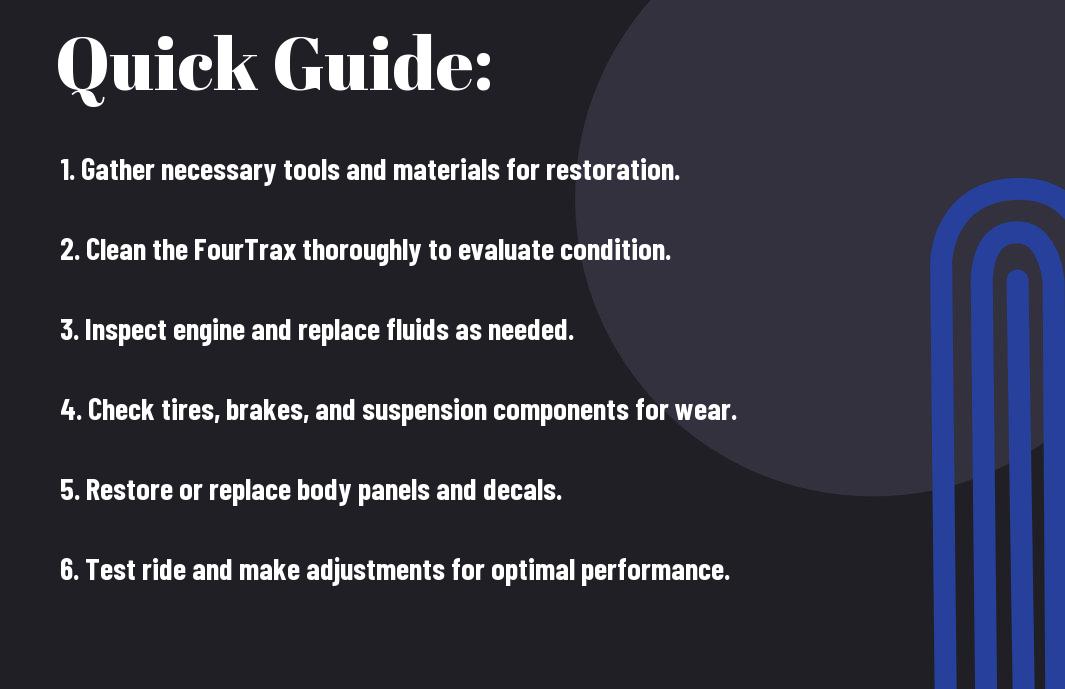
Unlike other restoration projects, restoring a 1990s Honda FourTrax requires a systematic approach. Breaking the process down into manageable steps can help you stay organized. Below is a simplified guide to assist you in your restoration journey:
| Step | Description |
| 1 | Disassembling the ATV |
| 2 | Inspecting and Repairing Components |
| 3 | Reassembly and Testing |
Disassembling the ATV
Disassembling your Honda FourTrax is the first step towards restoration. Start by removing the plastics, seat, and any accessories. Organize the removed parts and label them for easy reference. Don’t forget to take pictures during disassembly; they’ll be a valuable guide when you assemble later.
Inspecting and Repairing Components
Even after disassembly, your work is just beginning. Carefully inspect each component for wear, damage, or corrosion. Pay particular attention to mechanical parts like the engine, suspension, and brakes. This evaluation helps you identify any necessary repairs or replacements to ensure optimal performance.
Plus, don’t overlook smaller items such as hoses, gaskets, and electrical connections. Often, these components may seem insignificant but can greatly affect your ATV’s reliability. If you find any parts that are worn or broken, make a list for replacement or repair to keep your restoration on track.
Reassembly and Testing
You are now ready to start reassembly. Follow the reverse order of disassembly, taking care to reattach each part properly. Utilize your photos as a reference to ensure accuracy in placement. Once everything is securely in place, you can proceed to test your newly restored FourTrax.
A thorough testing phase is important. After reassembly, check all systems—engine start, brakes, and handling—to ensure everything function as expected. Be prepared for any adjustments needed after you’ve taken it for a test ride, as fine-tuning may be required for optimal performance.
Factors to Consider Before Restoration
After deciding to restore your 1990s Honda FourTrax, it’s important to weigh several factors before diving in. Consider the following:
- Condition of the ATV
- Availability of parts
- Time commitment
- Your budget
- Your technical skill level
After you’ve evaluated these aspects, you’ll be better prepared to start your restoration journey.
Budgeting for Parts and Labor
Labor costs can add up quickly during a restoration, so it’s wise to establish a realistic budget before you begin. Research the parts needed and their costs, as well as potential labor fees if you plan to hire a professional for more complex tasks. Consider setting aside a contingency fund to accommodate any unexpected expenses that may arise during the restoration process.
Assessing Personal Skill Level
Now that you’ve considered the financial aspects, it’s time to evaluate your personal skill level related to automotive repairs. Understanding your strengths and weaknesses is key to a successful restoration.
A comprehensive assessment will help you determine which tasks you can tackle yourself or which may require assistance. If you’re knowledgeable about engines, you might feel confident in handling mechanical repairs. Conversely, if your experience is limited, you may want to reach out to friends or professionals for guidance on specific tasks, ensuring a smoother restoration process.
Pros and Cons of Restoring a Honda FourTrax
Despite the appeal of restoring a classic Honda FourTrax, it is important to weigh the pros and cons before diving in. Below is a breakdown that can help you make an informed decision.
| Pros | Cons |
|---|---|
| Increases the vehicle’s value | Time-consuming process |
| Preserves the charm of a classic | Potential for expensive parts |
| Opportunity to learn mechanical skills | Requires significant effort and dedication |
| Sense of accomplishment | Availability of original parts may be limited |
| Ability to customize to your preference | May reveal unexpected issues |
Benefits of Restoration
Honda FourTrax restoration not only revitalizes a classic vehicle but also adds personal value to your collection. This process can enhance its market value, providing you with a potentially profitable investment. Additionally, restoring your FourTrax offers a rewarding experience where you can acquire practical mechanical skills, enabling you to gain further insights into ATV maintenance.
Potential Challenges
The restoration process can present various challenges that you should be prepared for. You might encounter issues such as sourcing rare parts or dealing with unforeseen mechanical problems, which can lead to delays and added costs.
Another challenge you may face is the time commitment required to complete the restoration. Finding the right balance between work, personal life, and your restoration project can be difficult. As you begin on this journey, anticipate that unexpected complications may arise, testing your patience and perseverance throughout the process.

Maintenance After Restoration
Once again, the key to preserving your restored 1990s Honda FourTrax is regular maintenance. Regular check-ups and timely repairs will keep your ATV running smoothly for many years to come. For inspiration, check out this 33 Year Old Honda TRX70 Fourtrax ATV Restoration … series that showcases ongoing care techniques.
Regular Upkeep Tips
Maintenance is not just a one-time task; it’s an ongoing responsibility. Follow these tips for regular upkeep:
- Check oil levels and change regularly.
- Inspect tires for proper inflation and tread wear.
- Clean or replace air filters as necessary.
- Lubricate all moving parts to prevent wear.
Knowing how to maintain your ATV will enhance its lifespan and performance.
Upgrades for Enhanced Performance
Upkeep of your Honda FourTrax can also include various upgrades. Enhancing its performance may require you to explore options such as aftermarket exhaust systems, upgraded air filters, and re-gearing for better torque. These modifications can significantly improve acceleration and efficiency, transforming your riding experience. Moreover, investing in better suspension kits can provide improved stability and comfort on rough terrains. Consulting with experts and fellow enthusiasts will help you determine the best upgrades for your specific model.
Understanding the available performance enhancements allows you to tailor your ATV to suit your riding style and needs. Choose modifications wisely to ensure compatibility and maximize your machine’s potential.
Final Words
Ultimately, restoring a 1990s Honda FourTrax can be a rewarding endeavor that enhances your mechanical skills while reviving a classic ATV. You will gain valuable experience as you identify parts needing replacement, tackle mechanical challenges, and personalize your ride to fit your needs. With a systematic approach and some patience, you can bring your FourTrax back to life and enjoy the satisfaction of riding a piece of history. Embrace the journey and enjoy every step of the process!
FAQ
Q: What tools are necessary for restoring a 1990s Honda FourTrax?
A: To successfully restore a 1990s Honda FourTrax, you will need a basic set of hand tools including wrenches, screwdrivers, pliers, and socket sets. Additionally, having specialty tools like a torque wrench, impact wrench, and a piston ring compressor may be beneficial. It’s also helpful to have a multimeter for electrical troubleshooting and a service manual specific to your FourTrax model for guidance.
Q: How do I assess the condition of the frame and body of the FourTrax?
A: Start by inspecting the frame for any signs of rust, dents, or cracks. Pay close attention to the welds and joints. The body panels should be checked for cracks or missing pieces, and any plastic components should be inspected for fading or brittleness. Use a flashlight to look into hard-to-see areas. Taking high-resolution photos can help document the condition and assist in planning your restoration.
Q: What are the common mechanical issues to look for in a 1990s Honda FourTrax?
A: Common mechanical problems include worn-out bearings, leaking seals, and issues with the carburetor. It’s also important to check the brakes, suspension components, and the condition of the tires. Inspecting the engine for signs of oil leaks, unusual noises, or smoke is also vital. These issues can often be addressed with simple repairs or replacements.
Q: Should I replace or rebuild the engine during the restoration?
A: Whether to replace or rebuild the engine depends on its condition. If the engine runs well and shows only minor wear, rebuilding it with new gaskets, seals, and possibly ring replacements may be sufficient. If the engine has substantial damage, like scoring in the cylinder or significant internal wear, replacing it with a good used engine might be the best option.
Q: How can I restore the electrical components of the FourTrax?
A: Start by inspecting all wiring for frays, corrosion, or damage. Clean all connections with electrical cleaner and replace any worn-out parts like the battery, starter relay, and fuses. Test all switches and ensure that the ignition system is functioning correctly. If possible, refurbish old components or consider upgrading to modern alternatives for better reliability.
Q: Which parts should I prioritize for replacement during the restoration?
A: Focus on safety and performance parts first. Prioritize the brakes, tires, battery, and any worn suspension components. After ensuring safety, move on to cosmetic parts like seat covers and body panels. Investing in quality replacement parts will improve the overall functionality and appearance of your FourTrax.
Q: How can I maintain my restored Honda FourTrax after the project is complete?
A: Regular maintenance is key to ensuring the longevity of your restored FourTrax. Create a comprehensive maintenance schedule that includes oil changes, air filter replacements, and checking tire pressure. Additionally, inspect the brakes and suspension periodically. Store the vehicle in a dry place and consider a cover to protect it from the elements to keep it in peak condition.
Leave a Reply