
When it comes to purchasing a UTV, knowing the dimensions is key. UTVs come in various sizes, and understanding their width, length, and weight can help you choose the perfect one for your needs. Whether you’re comparing models or looking for a specific size, this UTV dimensions guide will provide you with all the information you need.
Key Takeaways:
- UTVs come in different sizes, and knowing their dimensions is crucial for making the right choice.
- The width of sport-model UTVs ranges from 48 to 60 inches, while utility-model UTVs are typically between 58 and 64 inches wide.
- Two-seat UTVs are around 110-125 inches long, while four-seat UTVs are typically 135-160 inches long.
- Youth UTVs average about 48 inches wide and 85 inches long.
- Understanding UTV dimensions can help ensure the vehicle fits your intended use and meets any trail or storage limitations.
UTV Width and Comparison
When it comes to UTV width, there are two common options to consider: 48 inches wide and 60 inches wide. Let’s explore some specific models in each category:
48-Inch Width UTVs:
- Can-Am Maverick Turbo
- Polaris RZR XP Turbo
- Arctic Cat Wildcat
- Yamaha YXZ1000R
60-Inch Width UTVs:
- Arctic Cat Wildcat Sport
- Polaris RZR S 900
- Can-Am Maverick X xc
Each of these UTVs offers different features and capabilities, but their width remains consistent within their respective categories. It’s important to consider the intended use and any specific requirements you may have when choosing between these two width options.
Comparing UTV Widths
When comparing the 48-inch width UTVs, you’ll find that they offer a more compact and agile riding experience. These UTVs are often favored for tight trails and narrow off-road paths.
On the other hand, the 60-inch width UTVs provide increased stability and versatility. With a wider stance, these UTVs offer a smoother ride and improved stability when tackling rugged terrains.
Choosing the right UTV width depends on your specific needs and preferences. Consider where you’ll be riding and the terrain you’ll encounter to determine the best width for your adventures.
To visually understand the UTV width comparison, refer to the table below:
| UTV Model | Width (in inches) |
|---|---|
| Can-Am Maverick Turbo | 48 |
| Polaris RZR XP Turbo | 48 |
| Arctic Cat Wildcat | 48 |
| Yamaha YXZ1000R | 48 |
| Arctic Cat Wildcat Sport | 60 |
| Polaris RZR S 900 | 60 |
| Can-Am Maverick X xc | 60 |
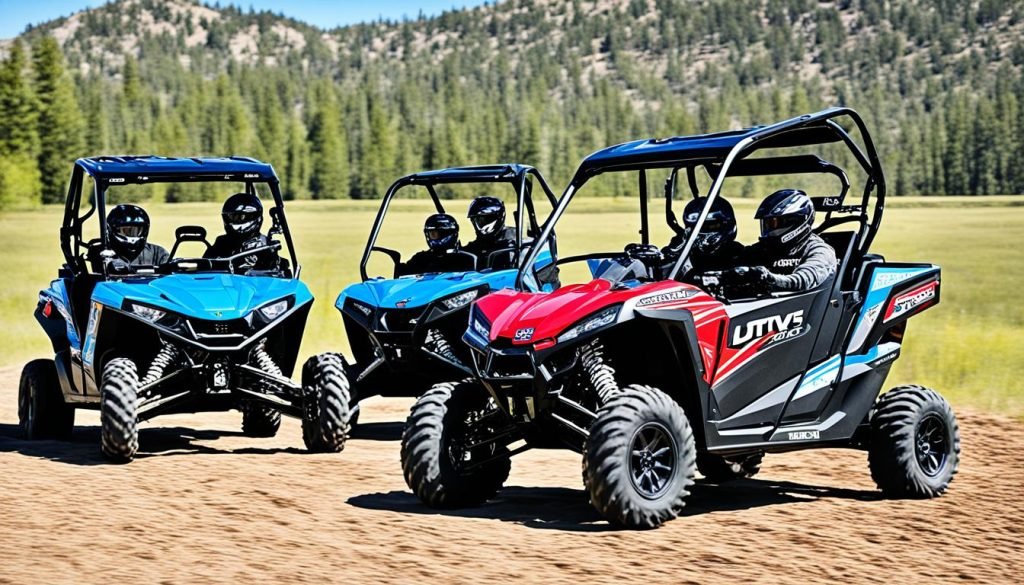
This image provides a visual representation of the UTV size comparison, displaying the different widths mentioned above.
UTV Length and Comparison
When considering the dimensions of a UTV, it’s important to take into account the length, especially when comparing models with different seating capacities. Generally, two-seat UTVs range from 110 to 125 inches long, while four-seat UTVs typically measure between 135 and 160 inches in length. Here are some specific examples:
| UTV Model | Length (inches) |
|---|---|
| Can-Am Maverick Max | 148.1 |
| Polaris RZR XP 4 900 | 134.4 |
| Polaris RZR XP 4 1000 | 146 |
These measurements give you an idea of the length of these specific UTV models; however, keep in mind that dimensions may vary slightly depending on the manufacturer and specific model.
Choosing the Right Length for Your Needs
When selecting a UTV, the length is an important factor to consider. If you plan on riding with only one passenger or need a more compact UTV for maneuverability on narrow trails, a two-seat UTV may be suitable. On the other hand, if you frequently ride with a group or require more space for cargo, a four-seat UTV offers the capacity you need.
Furthermore, it’s essential to consider the dimensions of your storage space or trailer to ensure the UTV can be properly stored and transported.
Having a clear understanding of the length of different UTV models allows you to make an informed decision based on your specific requirements and preferences.
Popular Sport Utility UTVs and Their Sizes
When it comes to sport utility UTVs, there are several popular models available on the market. Here are the dimensions of some of these UTVs:
| UTV Model | Width | Length |
|---|---|---|
| Polaris Ranger XP | 58 inches | 116 inches |
| Yamaha Wolverine X2 | 59 inches | 122 inches |
| Kawasaki Teryx4 | 61 inches | 125.4 inches |
| Can-Am Defender | 62 inches | 125.5 inches |
As you can see, the dimensions of these sport utility UTVs vary slightly. It’s important to consider the width and length of a UTV when choosing the right one for your needs. Take into account factors such as trail restrictions and storage space to ensure a perfect fit for your adventures.

With the information provided above, you can now make an informed decision about the size of the sport utility UTV that suits your requirements. Keep in mind that these dimensions are approximate and can vary among different models and manufacturers. Take the time to research and compare the dimensions of various UTVs to find the one that best fits your needs and preferences.
Popular Utility UTVs and Their Sizes
Utility UTV models come in different sizes, making it easier to find the perfect fit for your needs. Here are the dimensions of some popular utility UTVs:
| Brand | Model | Width (inches) | Length (inches) |
|---|---|---|---|
| Polaris | Ranger 570 | 58 | 108 |
| Can-Am | Defender HD10 | 62 | 125 |
| Yamaha | Wolverine X2 | 59 | 115 |
| Honda | Pioneer 700 | 60 | 114.8 |
These dimensions provide a rough guide to help you determine which utility UTV will best suit your specific requirements. Remember to consider factors such as towing capacity, cargo space, and seating capacity when making your decision. Now that you have a solid understanding of UTV sizes, you can choose the perfect one for your off-road adventures!
Youth UTV Sizes
If you’re looking for a UTV for young riders, it’s important to consider the size and dimensions that will be suitable for their needs. Youth UTVs are specifically designed with smaller dimensions to provide a safe and enjoyable riding experience for young enthusiasts.
These compact UTVs typically have a width of about 48 inches and a length of around 85 inches, making them easier to maneuver and control for younger riders. The smaller size ensures that young riders can comfortably reach the controls and maintain proper control of the vehicle.
Two popular youth UTV models that exemplify these dimensions are the Polaris RZR 170 and the Polaris Ace 150. Both of these models have a width of 48 inches and a length of 85 inches, providing a perfect fit for young riders.
| Model | Width | Length |
|---|---|---|
| Polaris RZR 170 | 48 inches | 85 inches |
| Polaris Ace 150 | 48 inches | 85 inches |
These youth UTVs provide a fun and safe introduction to off-road riding for younger enthusiasts. With their smaller dimensions, young riders can confidently navigate various terrains and enjoy the excitement of UTV riding.
UTV Weight
The weight of a UTV plays a significant role in its performance and handling. The weight can vary depending on the model and its specifications. Generally, UTVs tend to be heavier than ATVs due to their larger size and additional features. Understanding the weight of a UTV is important when considering factors such as towing capacity, maneuverability, and trail limitations.
Most UTVs typically weigh between 1,200 and 2,000 pounds. However, it’s important to note that the weight can vary based on the specific make and model. Two-seat sport models tend to be on the lighter end of the spectrum, while four-seat and utility models are generally heavier due to their increased seating capacity and cargo capabilities.
When choosing a UTV, it’s crucial to consider the weight in relation to your intended use. If you plan on tackling challenging terrains or navigating narrow trails, a lighter UTV may offer better maneuverability. On the other hand, if you require a UTV for heavy-duty tasks or towing, a heavier model with a higher weight capacity would be more suitable.
“The weight of a UTV can significantly impact its stability and handling, especially in uneven terrains. It’s important to choose a UTV with a weight that suits your intended usage to ensure optimal performance and safety.” – UTV Expert
UTV Weight Comparison
To give you a better understanding of the weight variations among different UTV models, here’s a comparison:
| UTV Model | Weight (lbs) |
|---|---|
| Polaris RZR XP 1000 | 1,498 |
| Can-Am Maverick X3 Turbo | 1,563 |
| Yamaha Wolverine X4 | 1,672 |
| Kawasaki Teryx KRX 1000 | 1,910 |
| Arctic Cat Prowler Pro Crew | 1,986 |
Keep in mind that these weights are approximate and may vary depending on the specific configuration and optional accessories of each UTV model.

What is a UTV?
A UTV, which stands for Utility Terrain Vehicle, is a type of off-road vehicle that is larger than an ATV (All-Terrain Vehicle). UTVs are designed for utility purposes and are commonly used for recreational and work-related activities.
Unlike ATVs, which are operated using handlebars, UTVs are driven using a steering wheel and have gas and brake pedals, making them more similar to regular automobiles. This feature provides a familiar driving experience and makes UTVs easier to control for those accustomed to driving cars or trucks.
One distinctive characteristic of UTVs is their size. These vehicles are typically larger than ATVs and can accommodate more passengers and cargo. UTVs are available in various seating capacities, ranging from two seats to four or more seats, depending on the model.
For added safety, UTVs are equipped with a roll bar or cage. This structure helps protect occupants in the event of a rollover or other accidents, making UTVs a safer option for off-road adventures.
Overall, UTVs offer a combination of performance, versatility, and safety, making them a popular choice among outdoor enthusiasts, recreational riders, and individuals in need of a capable utility vehicle.

Who Should Buy a UTV?
UTVs are a versatile option for various types of riders. Whether you’re a beginner or an experienced off-road enthusiast, there are several reasons why a UTV may be the perfect choice for you:
- Less experienced riders: UTVs are relatively easy to operate, making them suitable for riders who are new to off-roading. With their intuitive controls and stable design, UTVs provide a smooth and safe ride, allowing beginners to build confidence and improve their skills.
- Less physically capable riders: For riders who may have physical limitations or prefer a more comfortable and accessible riding experience, UTVs offer convenience and ease of use. With features like power steering and spacious seating, UTVs provide a comfortable and enjoyable ride for individuals with mobility issues.
- More utility and customization options: UTVs excel in their ability to tackle a wide range of tasks. Whether you need to transport equipment, tackle outdoor projects, or explore rugged terrains, UTVs offer ample cargo space, towing capacity, and customization options to meet your specific needs.
- Riders with more passengers: UTVs come in various seating configurations, making them perfect for riders who want to bring along family members, friends, or teammates. With four-seat options available, UTVs provide spacious seating and a social riding experience for group adventures.
- Riders who prioritize safety: Safety is paramount when it comes to off-road riding, and UTVs are designed with safety in mind. With features such as roll cages, seat belts, and advanced suspension systems, UTVs offer a high level of protection and peace of mind for riders who prioritize safety.
No matter your skill level, physical abilities, or specific requirements, there is a UTV that can cater to your needs, ensuring an enjoyable and reliable off-road experience.
| Buyer Profile | Why UTVs are a Good Fit |
|---|---|
| Beginners | UTVs are easy to operate and provide a stable ride, allowing beginners to gain confidence and improve their off-road skills. |
| Individuals with Physical Limitations | UTVs offer accessibility features such as power steering and comfortable seating, providing a more enjoyable riding experience for individuals with limited mobility. |
| Outdoor Enthusiasts | With their utility and customization options, UTVs are perfect for outdoor enthusiasts who need to transport equipment, tackle projects, or explore rugged terrains. |
| Group Riders | UTVs with multiple seating options allow riders to bring along family members, friends, or teammates for a social and adventurous off-road experience. |
| Safety-Conscious Riders | UTVs are designed with safety features such as roll cages, seat belts, and advanced suspension systems, ensuring a high level of protection for riders who prioritize safety. |
Conclusion
Understanding the dimensions of a UTV is crucial when choosing the right one for your needs. By considering the width, length, and weight of a UTV, you can ensure it fits your intended use and meets any trail or storage limitations you may have. Use this guide as a reference to find the perfect sized UTV for you.
When selecting a UTV, it’s important to know the width to navigate through tight trails or fit in narrow spaces. Sport-model UTVs typically range from 48 to 60 inches wide, while utility-model UTVs are typically between 58 and 64 inches wide. Youth UTVs average about 48 inches wide, making them easier to maneuver for younger riders.
The length of a UTV is also significant, especially if you require additional seating capacity. Two-seat UTVs typically range from 110 to 125 inches long, while four-seat UTVs can be as long as 135 to 160 inches. Having the appropriate length ensures comfort for both the driver and passengers during long rides.
Weight is another essential aspect to consider when purchasing a UTV. The weight can affect the UTV’s agility, stability, and trail performance. Most UTVs typically weigh between 1,200 and 2,000 pounds, with two-seat sport models being the lightest and four-seat and utility models usually heavier. It’s vital to choose a UTV with a weight that suits your needs and preferences.
FAQ
How big is a UTV?
UTVs come in varying sizes, with dimensions that depend on the model. This includes the width, length, and weight of the vehicle.
What is the width of a UTV?
The width of most sport-model UTVs ranges from 48 to 60 inches, while utility-model UTVs are typically between 58 and 64 inches wide.
Can you provide some specific UTV models and their widths?
Certainly! Examples of UTV models that are 48 inches wide include the Can-Am Maverick Turbo, Polaris RZR XP Turbo, Arctic Cat Wildcat, and Yamaha YXZ1000R. For a 60-inch width, there are models like the Arctic Cat Wildcat Sport, Polaris RZR S 900, and Can-Am Maverick X xc.
What is the length of a UTV?
Two-seat UTVs typically range from 110 to 125 inches long, while four-seat UTVs are usually between 135 and 160 inches long.
Could you provide specific UTV models and their lengths?
Absolutely! Specific UTV models include the Can-Am Maverick Max at 148.1 inches long, the Polaris RZR XP 4 900 at 134.4 inches long, and the Polaris RZR XP 4 1000 at 146 inches long.
What are the dimensions of popular sport utility UTV models?
Here are the dimensions of some popular sport utility UTV models:
What are the dimensions of popular utility UTVs?
Utility UTV models come in different sizes. Here are the dimensions of some popular utility UTVs:
How big are youth UTVs?
Youth UTVs are smaller in size compared to adult UTVs. They usually have a width of about 48 inches and a length of around 85 inches.
What is the weight of a UTV?
The weight of a UTV can vary depending on the model and its specifications. Most UTVs typically weigh between 1,200 and 2,000 pounds. Two-seat sport models tend to be the lightest, while four-seat and utility models are generally heavier.
What is a UTV?
UTV stands for Utility Terrain Vehicle. UTVs are larger than ATVs and are operated using a steering wheel and gas and brake pedals. They typically have a roll bar or cage for added safety.
Who should buy a UTV?
UTVs are ideal for riders who are less experienced, less physically capable, or in need of more utility and customization options. They are also suitable for riders with more passengers and those who prioritize safety.
Why is understanding UTV dimensions important?
Understanding the dimensions of a UTV is crucial when choosing the right one for your needs. By considering the width, length, and weight of a UTV, you can ensure it fits your intended use and meets any trail or storage limitations you may have.
Leave a Reply